Nitrogen Impacts
Sources of Nitrogen Deposition and Impacts at RMNP
Nitrogen deposited in high elevation ecosystems such as Rocky Mountain National Park (RMNP) affects these systems much differently than similar loads of nitrogen applied to lower elevation systems. The shallow soils and granite bedrock found in the Park lead to low chemical buffering capacity, and the short growing seasons at high elevations limit nitrogen use during the year. As a result, nitrogen loads as low as 1.4 lbs – N/acre can lead to harmful ecosystem impacts in the Park.
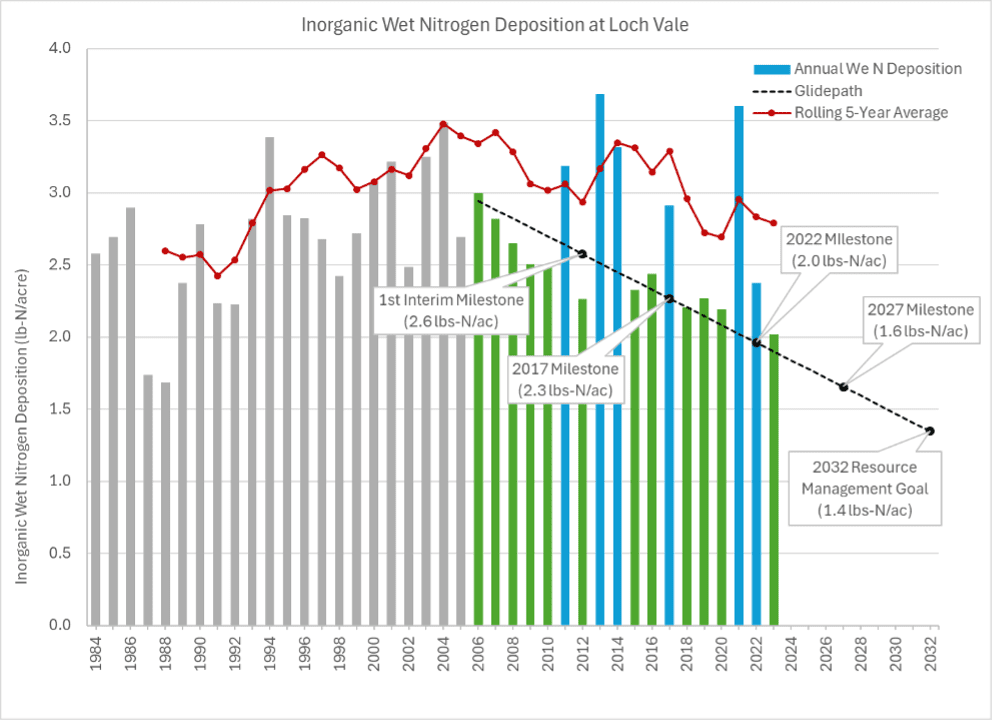
Wet nitrogen deposition at Loch Vale in RMNP has been monitored as part of the National Atmospheric Deposition Program (NADP) since 1983. Wet deposition occurs as reactive nitrogen compounds in the air are scavenged by rain or snow and deposit on soil, water, or vegetation. Increases in nitrogen deposition have been observed since monitoring began, but recent trends are relatively flat. When monitoring began, approximately half of the nitrogen deposited in oxidized forms (NOx, mainly products of combustion) and approximately half was reduced nitrogen (NHx, primarily from manure, fertilizer, fires, and natural emissions from soils). In recent years, ammonia/ammonium deposition has increased to almost 60% of the total wet nitrogen deposition.
Wet nitrogen deposition at Loch Vale in Rocky Mountain National Park. The “Glidepath” represents target deposition rates to reduce deposition to the resource management goal of 1.4 lbs-N/acre per year by 2032. Green bars indicate deposition values since adoption of the Nitrogen Deposition Reduction Plan that are at or below the Glidepath. Blue bars are years with above average precipitation, which results in higher wet deposition.
Harmful Effects
Harmful ecosystem effects that have been observed in RMNP due to increased nitrogen deposition include:
Alterations in diatom species (algae) in these lakes and streams, which can be an early indicator of declining aquatic ecosystem health.
Old-growth Engelmann spruce forests on the east side of the Continental Divide show a higher percentage of foliar nitrogen relative to similar forests on the west side.
Enhanced microbial activity in soils, which can alter biogeochemical cycling processes and lead to greater plant available nitrogen.
Nitrogen deposition in Swiss forests and its possible relevance for leaf nutrient status, parasite attacks and soil acidification.
Study Findings
The Rocky Mountain Atmospheric Nitrogen and Sulfur (RoMANS) study, published in 2009, sought to identify temporal trends in nitrogen deposition in RMNP as well as approximate the sources of emissions reaching the Park. Key findings of this report include:
Nitrogen deposition rates were about 2x higher in the summer than in the spring and resulted from very different meteorological processes.
In the summer, significant deposition occurred almost daily, as a result of convective activity.
In the spring, virtually all of the wet deposition resulted from a single, large-scale, upslope weather event.
In both the spring and summer sampling periods, average nitrogen concentrations in the air were highest in northeastern Colorado.
During the spring, the split between in-state versus out-of-state nitrogen sources was about 67:33; during the summer, the split was about 53:47.
Roughly half of the nitrogen deposition in RMNP comes from sources east of the park and half from sources west of the park. However, the weather events causing deposition from eastern and western sources are quite different:
In general, lower levels of nitrogen emissions come from distant sources west of RMNP and are transported by the prevailing westerly winds.
To the east of the Park are areas of high nitrogen emissions, including the nearby Front Range and agriculturally intensive areas in northeastern Colorado. These emissions can be transported and deposited at RMNP by easterly upslope events. These events are relatively infrequent; however, when they do occur, the Park often experiences its highest levels of nitrogen deposition. Prediction of these large upslope events is the basis of the pilot scale early warning system being developed and tested to try to reduce the contribution from agricultural operations in Colorado agriculture’s contributions to nitrogen deposition at impacts in RMNP.
References
Blett, T. and K. Morris. 2004. Nitrogen deposition: issues and effects in Rocky Mountain National Park Technical Background Document.
Malm, W.C., J.L. Collett, et al. 2009. 2009. Rocky Mountain Atmospheric Nitrogen and Sulfur Study Report. Fort Collins, Colorado: National Park Service. ISSN 0737-5352-84.